Posts

The Etymology of Polyglot

Image
    Figure 1:   A tongue that I quickly sketched, and then edited in photoshop. The Ancient-Greek 1st-and-2nd-declension adjective: πολύς, πολλή, πολύ , or, when transliterated: ‘polús, pollḗ, polú,’ means: ‘many,’ .  The Ancient-Greek 1 st -declension feminine noun: ἡ γλῶσσα, τῆϛ γλώσσης, or, when transliterated: ‘hē glȭssa, tē̃s glṓssēs’ means: ‘the tongue’ .  In the Attic dialect, the spelling of: ‘hē glȭssa,’ is: ἡ γλῶττα, τῆϛ γλώττης , or, when transliterated: ‘hē glȭtta, tē̃s glṓttēs’ . We derive our English noun: ‘polyglot,’ , which is a speaker of many languages, from our combining of the Ancient-Greek adjective: ‘polús,’ which means: ‘many’ , with the Ancient-Greek noun: ‘glȭtta’ , which means: ‘tongue’ .

Aristotle and the Law of Identity

Image
Figure 1:  I drew this pencil sketch of Aristotle. I consider Aristotle to be the great grandfather of computer Science.  To elaborate upon this is beyond the scope of this blogpost.  However, I consider this to be a huge motivating factor for my learning Greek:  should I ever complete a PhD in Computer Science, then this could make for an excellent subject for a thesis.  I hope to be able to read Aristotle in the original Greek, one day. I have read the philosophical novel, Atlas Shrugged  (1957) by Ayn Rand.  There is an Aristotelian theme running through the book.  Chapters are named after ideas from this philosopher. The Book is divided into three parts.  Part III is entitled: A is A .  This is a reference to the law of identity.  I believe that the law of identity, were it to be expressed in the Greek of Aristotle, would be: ἄλφα ἔστιν ἄλφα , or, when transliterated: álpha éstin...

Browser Shooting Game

Image
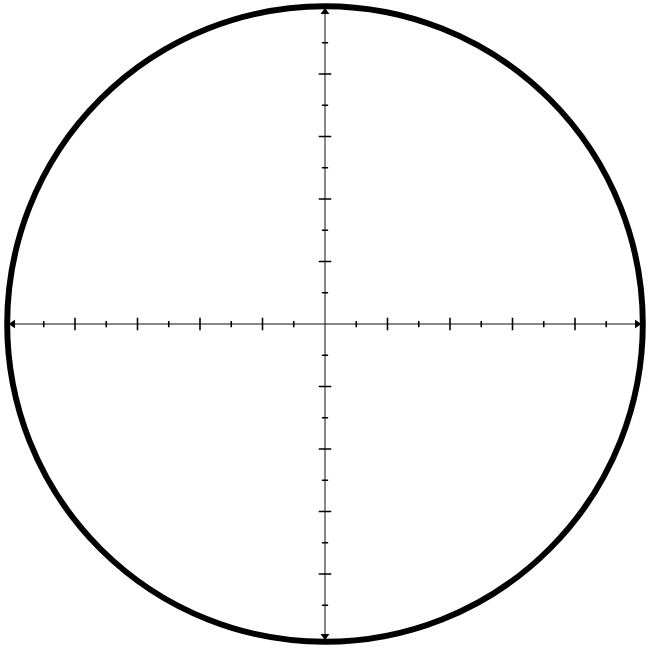
I drew this Rifle Scope in SVG. Should one construct a thick circle around a blank cartesian plane, then he gets a great rifle scope! One could employ - or rather deploy! - this image in a browser shooting game. I hope to begin experimenting with building simple browser games, shortly. ...

There Does Not Exist

Image
There Does Not Exist There Does Not Exist:      Figure 1:   A there does not exist symbol that I coded in SVG.      Figure 2:   What the SVG image depicted in Figure 1 looks like when exported as a .PNG file.      Figure 3:   The SVG code that generates the vector image depicted in Figure 1 . The symbol depicted in Figure 1 means: There does not exist .  This image is a rendering of the: There does not exist symbol as found in the: Cambria Math font as found in Microsoft Word . You may view the source code for this there-does-not-exists symbol at my Codepen  account. While I was at it, I re-rendered the: There Exists symbol so as to correspond with the symbol as rendered by the: Cambria Math font in Microsoft Word : There Exists Symbol (Cambria Math) ...

There Exists:

Image
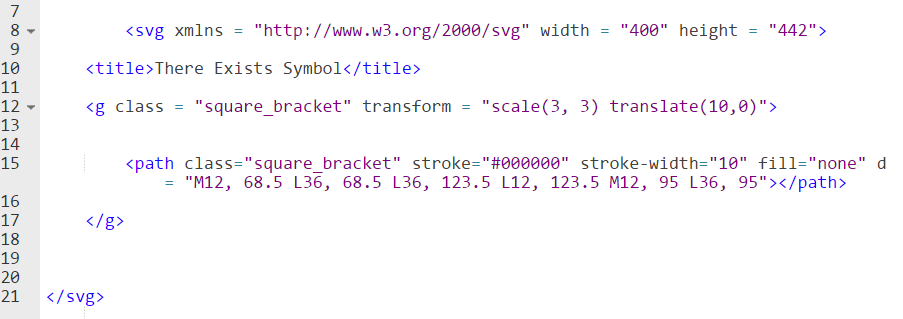
There Exists There_exists_symbol      Figure 1:   A there exists symbol that I coded in SVG.      Figure 2:   The SVG code that generates the vector image depicted in Figure 1 .      Figure 3:   What the above image, depicted in Figure 1 looks like when exported as a .PNG file. I believe that I could program better if I knew more Mathematics, and — to that end — I am following some Engineering-Mathematics courses on YouTube.  For instance: the more plane and Cartesian Geometry that I learn, the better I am able to script images in SVG. The symbol depicted in Figure 1 means: There exists . You may view the source code for this there-exists symbol at my Codepen  account.

SQL Venn Diagram

Image
     Figure 1:   A Venn diagram that illustrates how information, or data is grouped as regards Structured Query Language. How information is grouped together within programming languages is an important concept to grasp.  I find that the drawing of Venn diagrams assists me with this.

Was Exceeding Wroth

Image
Was Exceeding Wroth      Figure 1:    Homer Simpson "disciplining" his son, Bart.  Learning dead languages is difficult, which is why I like to draw pictures so as to aid me in this endeavour. The Ancient Greek word for: ‘rage,’ or: ‘wrath’ or: ‘divine anger’ is the 1 st -declension feminine noun: ἡ μῆνις [1] . or: ‘hē mē̃nis’ [2] . . The morphology of: ἡ μῆνις or: ‘hē mē̃nis’ is as follows: The Ancient-Greek 1 st -declension feminine noun: ἡ μῆνις or: hē mē̃nis:   Singular: Dual: Plural: Nominative: ἡ μῆνις τὼ μήνιε αἱ μήνιες Genitive...