Posts

Showing posts with the label maths

The Asterisk Symbol in C

Image
The Asterisk Symbol in C:     Figure 1:   I scripted this asterisk in SVG.  You can view the source-code of this asterisk at my Codepen account. This symbol, in the C programming language, represents the multiplication operator. Multiplication, in C, is a binary [1] .   multiplicative operation.      Snippet 1:   The above-depicted program illustrates the use of the asterisk, in C, as a multiplication operator.      Figure 2:   What the program depicted above in Figure 2  looks like when compiled and run. The asterisk symbol, in CSS, is termed ‘the universal selector.’  It targets all of the elements of an HTML 5 document, so as to apply the values of style properties thereto. In SQL, the asterisk symbol represents ...

The Set of Natural Numbers:

Image
     Figure 2:   The Natural Number Symbol that I scripted in SVG. The Natural Number symbol is a blackboard boldface ‘N’.      Figure 2:   The Natural Number Symbol exported as a PNG file. The set of Natural numbers can refer either to the set of non-negative integers, i.e.: {0, 1, 2, 3, 4, ...} or to the set of positive integers, i.e.: {1, 2, 3, 4, 5, ...} The term, ‘natural numbers,’ refers to quantities observed in nature. One can have two apples; three pears or five bananas; how...

An Introduction to Modern Geometry: The Directed Line Segment

Image
Introduction to Modern Geometry Modern Geometry: The Directed Line Segment In Euclidean Geometry, line segments possess only magnitude, and not direction. A B      Figure 1:   In Euclidean Geometry, only the magnitude of line segments is considered. As we can see in Figure 1 , in Euclidean Geometry, the line segment: |AB| would be considered equal to the line segment: |BA| . However, this is not the case with Modern Geometry. In Modern Geometry, line segments not only possess magnitude, but direction also. A B      Figure 2:   In Modern Geometry, line segments possess direction as well as magnitude. In Modern Geometry: |AB| is termed: ‘a directed line segment’ . ...

There Does Not Exist

Image
There Does Not Exist There Does Not Exist:      Figure 1:   A there does not exist symbol that I coded in SVG.      Figure 2:   What the SVG image depicted in Figure 1 looks like when exported as a .PNG file.      Figure 3:   The SVG code that generates the vector image depicted in Figure 1 . The symbol depicted in Figure 1 means: There does not exist .  This image is a rendering of the: There does not exist symbol as found in the: Cambria Math font as found in Microsoft Word . You may view the source code for this there-does-not-exists symbol at my Codepen  account. While I was at it, I re-rendered the: There Exists symbol so as to correspond with the symbol as rendered by the: Cambria Math font in Microsoft Word : There Exists Symbol (Cambria Math) ...

There Exists:

Image
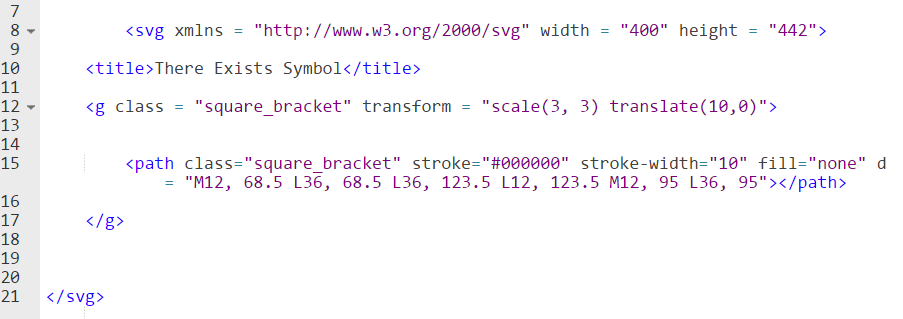
There Exists There_exists_symbol      Figure 1:   A there exists symbol that I coded in SVG.      Figure 2:   The SVG code that generates the vector image depicted in Figure 1 .      Figure 3:   What the above image, depicted in Figure 1 looks like when exported as a .PNG file. I believe that I could program better if I knew more Mathematics, and — to that end — I am following some Engineering-Mathematics courses on YouTube.  For instance: the more plane and Cartesian Geometry that I learn, the better I am able to script images in SVG. The symbol depicted in Figure 1 means: There exists . You may view the source code for this there-exists symbol at my Codepen  account.

The Phi Quadrilateral

Image
The Phi Quadrilateral. Phi Quadrilateral a b x y c d      Figure 1:   A Phi Quadrilateral that I coded in SVG.  I believe that these are used for perspective.  The first quadrilateral will have its base line-segment at the bottom of the canvas, in the foreground.  A second quadrilateral - scaled to 0.618033988... the size of the first, will have its base equal in magnitude to the top line segment of the original quadrilateral.  This second quadrilateral has its base at the top line segment of the first quadrilateral. ...

The Naming of Sets in Set Theory:

Image
The Naming of Sets in Set Theory Figure 1:   I drew this set-naming italic character in SVG.  You may view the code of this image at my Codepen Account . Figure 2: What the SVG image looks like when exported as a PNG. [1] In Set Theory - which underpins so much of computing mathematics - we conventionally name sets with capital italic letters. In computer science, a name such as: A , would be termed an: ‘identifier’ . In the below example, we shall use the capital italic character: R so as to name the members of the set of Radix-ten [2] integers. Figure 3: “ A SQUARE-ROOT SIGN   This sign is from radix (Latin for root) and was first used by Leonardo da Pisa in 1220.  Today’s √ sign, which may be a distortion of the letter “r”, is sixteenth-century German.” [3] An Example ...